Skip to content

Week 3: Understanding & Developing Content for the Web

In our last post we explored the role of navigation in providing a structure or road map for your website. Sticking with the road map metaphor - content is the destination.

Content is a range of items; text, photos, drawings, charts, graphs, videos, links to other websites, bulleted information, testimonials from customers; the list goes on. To put it simply: content is all the information that will be on your website. Navigation gives your audience access to your content in digestible, purposeful amounts and sequence.

Content is how you communicate with your visitors; how you appeal to them emotionally and express the character of your organization. It is also how you provide sought after information.

Read more

Week 2 : Website Navigation Basics

Website Navigation Basics

Navigation Should Be Intuitive

The navigation on your website exists to make it easy for your visitors to engage with your content. Because the aim is to make the experience frustration-free, website navigation is not the place to get creative and try to “break the mold.” Instead, navigation should be rooted in web convention  and based on the habits of how we use the internet.

Navigation Should Be Simple

Once we consider that we have a only fraction of a second to grab and hold the visitor’s attention it becomes clear how we can potentially lose users if they can’t find what they are looking for. It’s best to keep things simple when it comes to web page navigation. There are  some basic standards that capitalize on expected behaviors and anticipate how we read websites that make certain your site is simple and easy to use.

Let’s take a look at a few standard website navigation principles:

Read more

Understanding Web Design – Breaking Down the Elements on your Webpage

Web Design Blog IntroductionOur design team at Synerge Marketing is excited to announce a new blog series in which we’ll take a look at the different components of website design and break down the process we use to determine and prioritize different elements on your website. Our hope in expressing these steps is to give you a sense of the shape projects take as they evolve. This series will also make it possible for you to organize your vision and ensure that your website meets your—and your audience’s—needs.

To start, we will look at each different area of a website. Understanding user expectations, conventions, and opportunities for innovation will help ground our process in a focus on user experience. We hope to illustrate how each piece of design reflects your goals and your web presence. Most important to your website are on the goals of your individual business, and we hope this overview will help you begin to prioritize and plan for your new or updated website.

Over the next few weeks we will cover the areas listed below in individual posts. Use the links here to access topics as they become available.

Week 1 : Introduction
Week 2 : Navigation
Week 3 : Content
Week 4 : Photography
Week 5 : Footer
Week 6 : Call to Actions
Week 7 : Social Icons
Week 8 : Fonts
Week 9 : Colors
Week 10 : Overview of Visual Hierarchy
Week 11 : Your website – what do I want people to do next?

Read more

Synerge-marketing Launches Wesson Energy Site and Rebranding Effort

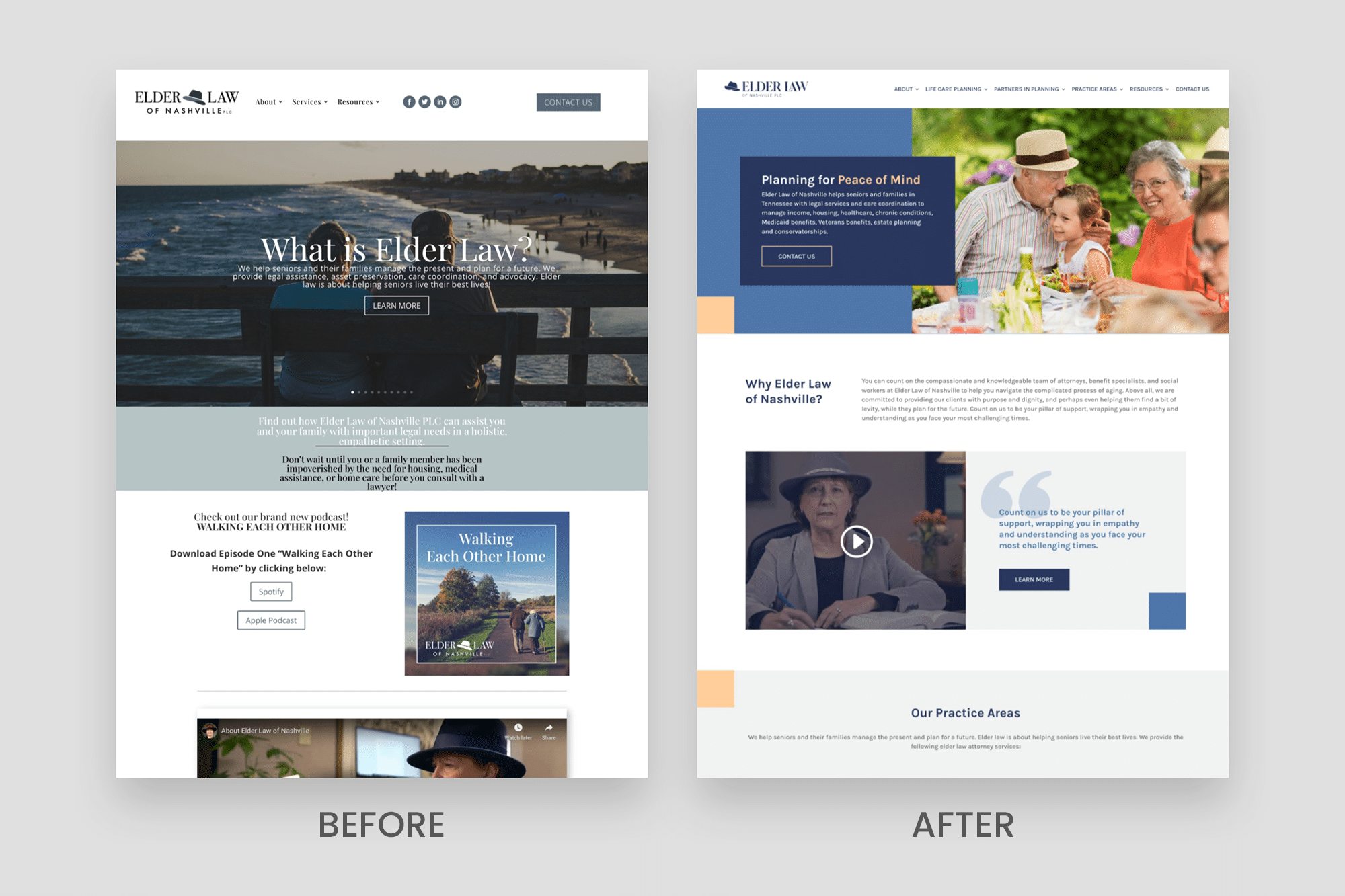
Wesson Energy New Website Design, CTSometimes an established company needs a new brand — one that highlights how the company has changed and is growing with the times. At the same time, it’s important to give due credit to the past. For example, this might mean emphasizing the company’s longevity and its hard-earned reputation for exceptional products and services.

Wesson Energy, based in Watertown, Connecticut, is such a company. Founded more than 70 years ago, Wesson management decided a few years ago that the business of the company’s future was to sell its customers less fuel and more services, including Connecticut energy audits, alternative energy installation and home performance contracting. In other words, Wesson needed to be viewed as a company that provides energy-efficiency services that “Save More by Using Less.” This change in approach was not reflected in the company’s old website, which focused on Wesson’s traditional oil delivery services.

To help bring its website and branding in line with the company’s new approach, Wesson enlisted Synerge-marketing earlier this year. The result is a new website that was launched earlier this week. The new wessonenergy.com includes a brand new web design and structure, a new look and even a new logo — all centered around Wesson’s focus on improving home efficiency.

Read more

Three Search Engine Marketing Tactics That Have Surged in 2012

Search engine marketing tools and tactics are in an ever-changing state of flux. Search engine juggernaut Google regularly announces significant changes to their algorithms (they announced 40 changes to their various search engines earlier this year, followed by the Penguin update in  April). On top of that, powerful new search engine marketing and optimization tools are launched almost daily and existing tools are routinely enhanced.

How can you keep up?  Get on board and add these three tactics to your online marketing strategy this year:

  1. Guest Blogging - This time last year many in the search engine optimization (SEO) community were still reeling from Google’s first infamous Panda update. Panda – Google’s code name for a massive search algorithm change also known as the Farmer update – fundamentally altered the SEO landscape by placing tremendous importance on quality content. Read more

Synerge-marketing Launches Pickle Peas E-Commerce Site

Pickle Peas E-Commerce Web DesignNew start-up businesses are thriving.  We get several requests a month from clients seeking to develop a web presence for a new idea, product or service.  They know that without a website, their company has no credibility whether they are targeting investers, partners, businesses or consumers.  Shannon Byrne came to us early in the year looking for help with an ecommerce web design focused on a line of baby clothes and bibs targeted to mom’s dealing with drooling babies.  She is raising 3 children currently, all who are droolers and she turned her problem into an idea and business.  Her clothes are 100% organic cotton, rugged, comfortable and stylish.  The idea is that the bib is interchangeable with the outfit and instead of clashing with the outfit, it is designed to coordinate and look like an applique.  The bib keeps the baby dry and happy, and can be easily snapped off and on with other coordinating bibs so mom doesn’t have to dress and undress repeatedly throughout the day.

We wanted a design that would appeal to modern, upscale moms that could afford to invest in really cute clothes that actually served a purpose.  We used the Big Commerce platform to achieve Shannon’s goals on a tight start-up budget.  Because the competition for “organic baby clothes” was competitive, we targeted keywords that surrounded a problem that moms face – drooling, teething and spitting up.

Check out Pickle Peas site here: Interchangeable Outfits and Bibs for Drooling Babies

The Pros and Cons of Pay-Per-Click Advertising for E-commerce Websites

Pay Per Click AdvertisingSearch engine advertising – also known as pay-per-click (PPC) advertising – is one of the more evolved advertising options available to businesses, as it has a few key advantages over traditional advertising:

1. You only pay for performance. Unlike TV, radio, or print advertising, PPC ads only cost you money when people click on your ad and visit your site.
2. Your ads can be highly targeted. Whether you’re buying clicks from Google’s AdWords program or Facebook Ads, PPC advertising offers a level of targeting that mass media can’t match. You can target by search term, demographics, consumer interests, and/or geography.
3. Budget doesn’t matter. In the world of television advertising, for example, it’s very difficult for small and medium-sized businesses to compete, as a relatively “cheap” TV ad campaign will cost upwards of $15,000 a month. However, in the world of PPC, many businesses can run an effective ad campaign for less than $1,000 a month.

Still, PPC advertising isn’t perfect. E-commerce website owners in particular must manage their PPC campaigns very closely, or they risk wasting money on clicks that don’t convert. If you own or manage an e-commerce website and you’re thinking about a PPC campaign, here’s what you need to know.

Read more

Tips For Optimizing Press Releases

Marketing methods come and go, but in this digital age the traditional press release seems to be here to stay.  There’s a good reason for this: If you’re able to rank well on popular online news websites and in search for your optimized keywords, press releases can offer attractive benefits at a reasonable cost.

To ensure that your press release gets the best possible search engine results, it’s a good idea to review the following questions.

What’s the Best Word Count for a Press Release?

Even if you have a perfect headline and the best keywords, the length of your press release can make or break its optimization. If the press release is too long, search engines can’t index it as specifically. If this happens, your press release may drop out of the top search results, making it less likely to be found online.

The optimum press release length for SEO is 400 to 600 words. A press release should be concise and easy for readers to comprehend but long enough to include some relevant details with color — the information that readers find interesting and which search engines latch onto.

How Do I Optimize a Press Release Headline?

Read more

Synerge-marketing Launches Bump Agent for Travelers

Bump Agent CT Web Design - Synerge-marketing

Bump Agent Website

Bump Agent, a website designed and developed by Synerge-marketing,  launched this week.   Bump Agent is a new concept targeted to flexible travelers.   People that sign up are notified more than a day in advance if their flight is overbooked and receive valuable travel incentives to rebook on an alternate flight.   It’s bumping with benefits.  The system helps the airlines keep passengers (and flight crew) happy,  and it helps passengers by providing rewards and convenience for rebooking.  Smart Idea!

The challenge was to create a new brand that appealed to business and leisure travelers, college students and empty nesters.    We needed to design a website that brought the visitor through the concept, benefits and sign up without any effort.   The goals were to make the brand distinctive, deliver the message clearly, and engage vistitors to sign up for free.

For this challenge, we decided to take the visitor through the bump agent story and benefits, and invite visitors to “get onboard” all within a single web page.   An airplane and flight path lead the visitor down the page and to the call to action.  Our web designer, Kim, combined old fashioned airport icons and nostalgic graphics with bold colors and modern background scenes.   The forms were designed as a “ticket”.

Our developer, Garry, made the functionality elegant and effortless.   He was able to integrate the forms, rotating surveys and refer a friend  all within a single process and without leaving the page.  The forms were programmed to rotate so that the client would receive a variety of feedback from visitors relating to the service.  All this was custom programmed without using any 3rd party software.  Not an easy feat.

The Synerge-marketing team of  web designers and developers worked together to come up with a website that was original, compelling, intuitive and fun.    Untraditional in both design and function, we’ll be interested to see how it is received and look forward to the phase 2 version including “My bump agent” profile and full registration.  Check it out:  http://www.bumpagent.com/ And Stay Tuned.

A New Frontier: The Google Plus Experience

Why is Google+ better suited for my new professional career and social life? First, let me explain how I came about pursuing a new social media platform like Google+.

As a recent college graduate, navigating my way through the business world, I had been worrying about how my social profiles might affect my chances of landing a new job. Facebook and Twitter were my main streams of communication, but with employers investigating facebook and twitter accounts, I find myself with the new challenge of separating my professional life from my social one. This is a topic that often arises when grassing at the local bar with acquaintances that have parallel feelings. Read more